Designed to help pet owners and breeders make informed, responsible genetic decisions.
Example of Dog DNA Results
General Health Risk
Snoopy
Overall risk
Low
Clear10 / 16
Перевозчик4 / 16
At risk2 / 16
Your report explains each result with interpretation and practical guidance.
Health risk by category
Snoopy
Шӱм-вӱргорно чер-влак23 DNA tests
Clear20
Перевозчик2
At risk1
Неврологический чер-влак120 DNA tests
Clear112
Перевозчик7
At risk1
Example only. Your final report include all categories depending on the panel.
Genetic health risk details
Snoopy
MDR1Drug sensitivity
N/MDR1Перевозчик
DMDegenerative Myelopathy
N/NClear
HUUHyperuricosuria
HUU/HUUAt risk
vWD1Von Willebrand disease
vWD1/vWD1At risk
Example only. Your final report lists every tested condition with interpretation.
Coat color and traits
Snoopy
Easy-to-read genotype explanation included.
Coat color:BlackDilution:NoCoat length:Short
Agouti geneA/a
Long coat geneL/L
Dilution geneD/D
Perfect for understanding inherited coat traits.
Genetic identification
Snoopy
Analysis ID#220256
DNA Markers analyzed250+
DNA markers obtained100%
Inbreeding coefficient
Snoopy
COI
6.4%
Lower values indicate greater genetic diversity and lower inbreeding
0%10%20%30%+
Your report explains how inbreeding coefficient is calculated and how to interpret it.
Breed
Snoopy
Estimated ancestry percentages.
Labrador Retriever
52%
Border Collie
28%
German Shepherd
12%
Other
8%
Why a genetic check-up matters
Your pet can look perfectly healthy—yet many inherited conditions develop silently.
Prevention is protection
Your pet can look “fine”… while risks stay invisible
Many inherited conditions can progress for months or years without obvious symptoms.
A DNA check-up helps you anticipate and act earlier—often with simpler, safer choices.
🧬
Detect hidden health risksIdentify genetic predispositions before symptoms appear, so you can monitor what matters.
💊
Anticipate medical sensitivitiesSome pets have genetic sensitivities to certain medications. Knowing this can help guide safer care.
🩺
Support smarter veterinary follow-upGive your veterinarian additional clues to tailor prevention, screening, and long-term wellness.
🧾
Useful for breeding & traceability (optional)Carrier status and genetic identification can help with responsible breeding and records.
✅ Prevent & manage genetic risks
Identify predispositions to hereditary diseases
Adapt monitoring and prevention early
Make informed decisions with your vet
🎯 Make better breeding & health decisions
Know carrier status (recessive conditions)
Reduce risk for future litters
Choose compatible pairings responsibly
🪪 Know your pet better
Coat color genetics & traits (when applicable)
Genetic identification for traceability
Clear, easy-to-read results
✖Without DNA testing
→
✔With a genetic check-up
Hidden risks remain unknown
→
Early detectionto spot risks in their DNA
You react after symptoms appear
→
Active preventionbefore symptoms
Generic decisions
→
More personalized choicesfor wellness and follow-up
DNA analyses are performed following strict quality standards.
Tip: Genetic screening is useful even for healthy animals—many conditions are “silent” until later.
Genetic check-up: is it useful for your pet?
Answer a few questions (1–2 min) to get a tailored recommendation.
пийпырысимне✅ Genetic check-up strongly recommended✅ Genetic check-up recommended✅ A test could be usefulFor your pet:For:based on your answers (goal:, age:), here is our recommendation:Ahealth panel(hereditary diseases) adapted to the species.Consider checking for possiblegenetic drug sensitivities(when applicable).Includecarrier / non-carrier statusfor recessive conditions (useful for breeding).Add acoat color / traitstest to understand inheritance.Addgenetic identificationfor traceability and verification.Reported issues:→ consider a more comprehensive health panel.You don’t know the blood type → testing can be helpful to prepare for emergencies.← BackContinue →DoneSee my recommendation →
Before we start
Optional, but makes the recommendation friendlier 🙂
Choose the species so we can suggest the right tests.
Age & goal
Tip: even a “healthy” animal can be a silent carrier.
Veterinary info
Useful information in case of surgery or emergencies.
Sensitivities & health
Some genetic sensitivities exist (depending on species/breed).
This does not diagnose—it's to help orient you toward relevant panels.
⚠️ This quiz provides guidance, not medical advice. If symptoms are severe, consult your veterinarian.
How to Collect Your Dog’s DNA Sample
✨
Animal welfare first
Sampling is very simple to do at home. It’s quick, gentle, and painless for your animal — designed with their comfort and wellbeing in mind.
Quick (≈ 1 min)Simple at homePainless
Great news! Your home sampling kit has arrived.
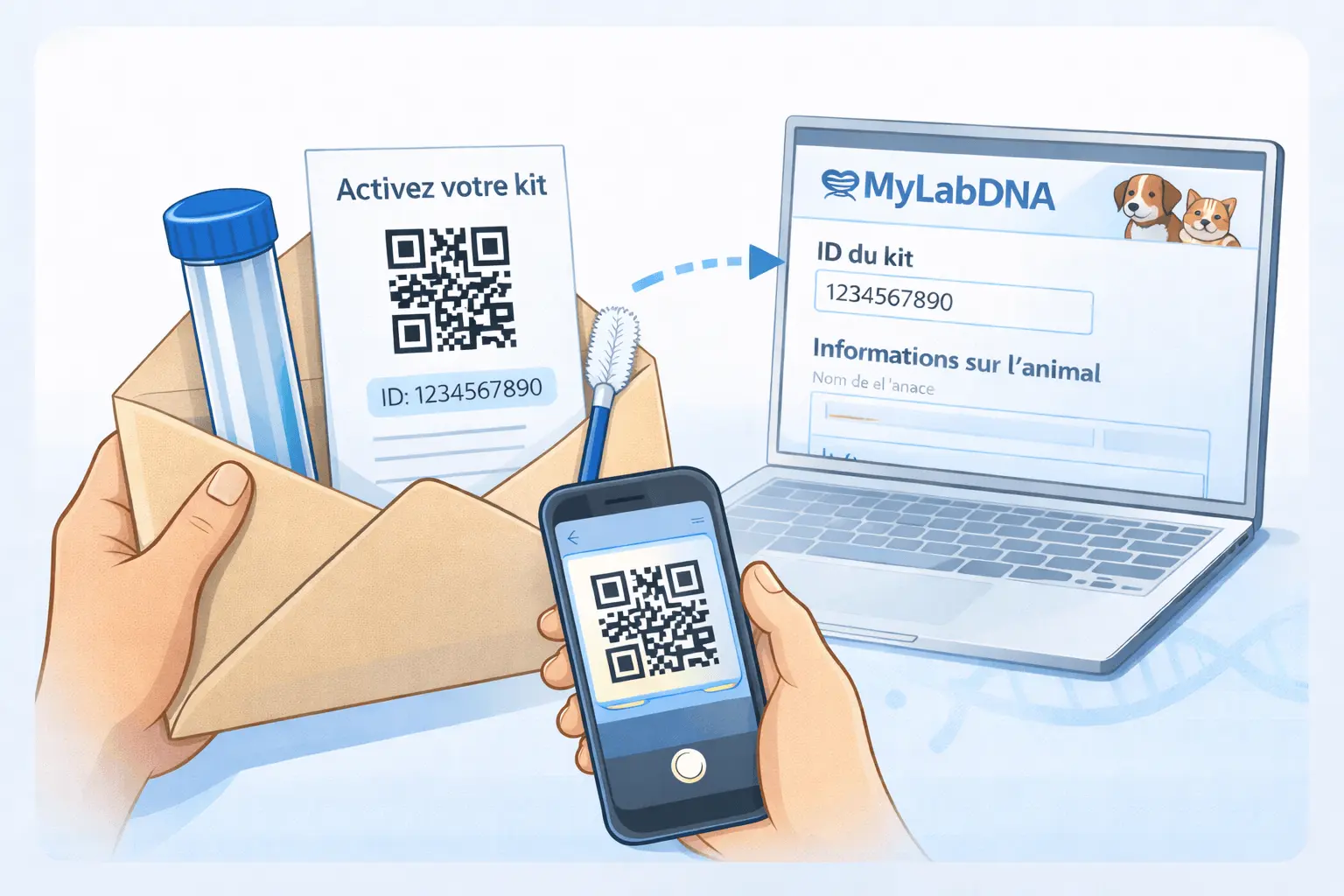
To get started, simply scan the QR code or visit the link provided to activate your kit and register your animal’s information.
To get started smoothly, please take the cytobrush and the tube containing the preservative solution.
Begin by gently inserting the tip of the cytobrush into your dog’s mouth, placing it softly against the inside of the cheek.
Move slowly and calmly to ensure your dog remains comfortable during the sampling process.
Gently rub the cytobrush against the inside of your dog’s cheek, rotating it for about20 seconds.
If needed, you may use your other hand to softly hold the cheek against the cytobrush to ensure good contact and an effective sample collection.
Please make sure not to rub the cytobrush against your dog’s tongue and to avoid collecting saliva as much as possible.
The cells containing the DNA required for analysis are located against the inside of the cheek, not on the tongue. Proper contact with the cheek is therefore essential to obtain a high-quality sample.
Once the sample has been collected, gently remove the cytobrush from your dog’s mouth.
Then cut the cytobrush shaft about one centimeter above the cytobrush head and place the cytobrush head into the tube containing the preservative solution.
Carefully close the tube by screwing the cap on tightly to ensure a secure seal.
Make sure it is properly closed to prevent any leakage of the preservative solution.
Place the tube containing the cytobrush along with the sampling certificate into a padded or cardboard envelope to protect them during shipping.
Then send everything to the laboratory at the address provided in your kit.
See the sampling steps for other species
Choose your animal to view the step-by-step guide.
“We tested Rocky for hereditary diseases before breeding. The results were clear, professional, and delivered faster than expected. It gave us real peace of mind.”
🐱
Lucas & Luna(British Shorthair)
★★★★★
“The genetic color analysis was incredibly detailed. The report was easy to understand, even for a non-expert. Highly recommended!”
🐴
Claire & Orion(Sport Horse)
★★★★★
“The DNA identification and parentage verification were precise and well documented. Excellent support from the MyLabDNA team.”